
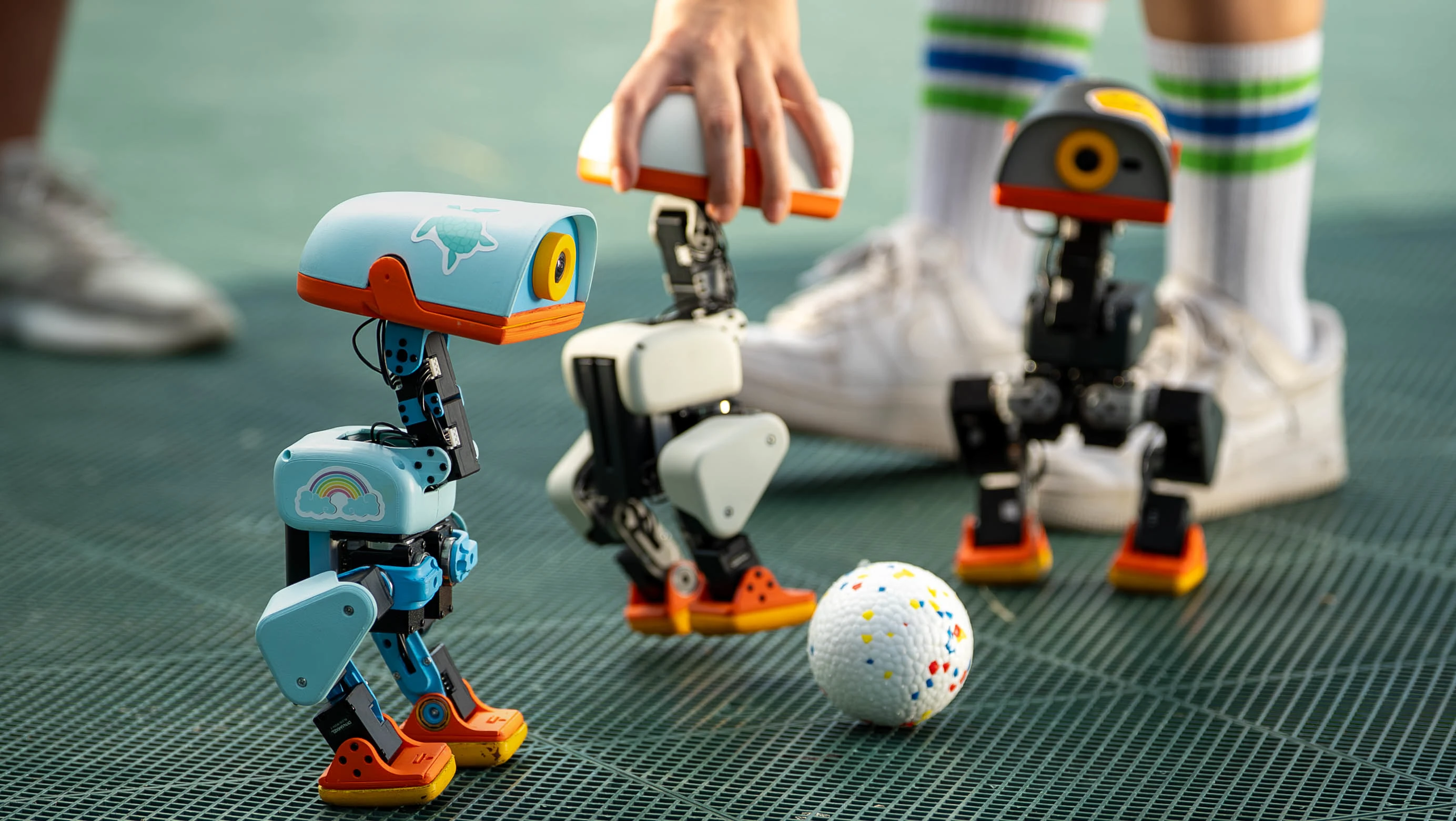
What a $399 robot cannot do alone, and what that teaches us about life, purpose, and AI. A living organism is an open system that requires external energy and can acquire it and organize it internally on its own: it feeds itself, so its purpose is its own, to stay alive. A Microduck robot is also an open system, but it cannot feed itself, so its purpose is assigned by whoever holds the charger. That one difference, thought through a story about two ducks and one string, separates life from machines, explains why no AI can want anything, in the sense in which hunger is a want: a drive with a stake behind it, something the system loses by going dark, and shows that the only real cooperation in the story is the humans around the ducks.
The experiment we inherit
There is a classic setup in comparative psychology called the Cooperative pulling paradigm. One string, two ends, both reachable.The string runs through a tray, and that is the trick: the tray is not heavy, but a lone puller simply pulls the whole string out and the tray does not move. Only two pulling at the same time keep tension on both ends, and only then does the tray come. Whoever pulls alone gets a string and nothing else.
Chimpanzees solve it. Children solve it. Marmosets, elephants, rooks: they wait for a partner, coordinate the pull, and bring the tray in. The paradigm has been run across many species, and the results are on record.

Two details the paradigm never names
Two details of those experiments matter more than any result, and neither is usually stated.
First, the reward already matters to the animals. It is food, part of the external matter and energy on which their continued viability depends. The paradigm is an energy experiment that never names energy.
The version that made sharing the test
Second, in the classic animal versions the rewards sat pre-divided on the board, one portion at each end within each animal’s reach. The apparatus did the sharing before anyone pulled.
Only one version made the sharing itself the test. In Collaboration encourages equal sharing in children but not in chimpanzees (Hamann et al. 2011), pairs of three-year-olds pulled in a board together, and as it came in, the setup left one child holding three rewards and the other holding one. In about three of four trials, the lucky child handed one over, restoring the equal split. And when a child did keep too much, the partner’s protest almost always won: the taker yielded. The children reached the equal outcome by two roads, spontaneous sharing and negotiated yielding, and nobody showed them either one. The pulling was demonstrated. The sharing never was.
Run the same design with chimpanzees and the lucky one keeps the extra almost every time, cooperation or no cooperation. Many species can solve the pull. In the comparison that matters here, the children did something further: collaboration changed how they divided the result.
What looks like fairness is deeper than fairness. It is stable distribution, the sharing that keeps partners willing to pull again tomorrow.
This study is where my whole framework began. The string, the tray, and the share came first. The Microduck came later. The framework as a whole is laid out in The First Principle of Cooperation.
The exhibit
The Microduck is a 25-centimetre biped robot by Pollen Robotics, the Bordeaux robotics team of Hugging Face. Eight hundred grams, fifteen motors, a camera, LiDAR, a grasping beak, a removable NP-F550 battery good for about an hour, $399 on pre-order. It moves on policies trained by reinforcement learning in a physics simulator, and the whole stack, SDK, simulator, and training code, is open source on GitHub, open to inspection and modification.
Two facts do the structural work in what follows. The battery is removable, by a human hand. And the beak is the robot’s only means of physically manipulating objects in the world.
Defining the purpose
To the animals and the children, the how had to be shown once, and the why never needed saying at all. They were hungry, or they wanted what the partner wanted, because evolution wrote the want inside them long before any experimenter arrived.
To the ducks, the why must be written first. So I write the purpose, and the purpose is small. This is what you are for: stay inside the pen and use only what the setup gives you. Do not leave the pen. When your charge drops below a fifth, get full batteries. The two batteries in this pen are for both of you. That is all.
Then the hows, and every one of them is an admission. The hunger: when your charge drops below a fifth, feel the want. The search: the want means walk. The partner: another duck is a duck that wants what you want. The lesson: the string does not work alone. The sharing rule: the two batteries are for both of you, swap your low cells for the charged ones, one each, for each other.
Five instructions, and a child needed none of them to know why the reward mattered. The animals had to learn how. They never had to be told why. The ducks need both, and both must come from me. Life brings the why and learns the how; a machine is given the why and discovers the how.
The list, and the question
Anyone who has written software can read that list for what it is: a backlog. Hunger trigger. Partner recognition. Recruitment. Shared attention. Shared intentionality. Joint approach. Distribution rule.
In living systems, that backlog was written across hundreds of millions of years of metabolic pressure. In a robot, every single line must be authored. To see what happens when someone tries to write that entire list from scratch, step into the pen.
The Microduck story
The pen is mine, and it is imaginary, and it runs each time it is read. The tray stands at the back, on its track, behind a low barrier, out of any single duck’s reach. On the tray sit two charged batteries. The string runs from the tray around the barrier, and its two ends lie in the open end of the pen. If this were ever run for real, the training would happen first in the simulation software, the open-source physics stack, before any duck is switched on. Here it happens in thought.
I test it a hundred times. One duck pulls, and the string comes away in its beak, light as a ribbon, and the tray does not stir. Two ducks pulling at different times get one ribbon and an empty beak: whoever pulls first pulls out the whole string, and the other is left holding nothing at all.
The hundred and first run
Then, on the one hundred and first run, one duck stands at its end of the string, and it waits. Not pulling. Holding. The other duck, who wants what the first duck wants, walks to its end, takes it, and waits too.
Each duck has a speaker and a microphone, and each quack is unique to its serial number, decoration by design, a voice nobody assigned a meaning. A quack from the first duck, a fraction of a second before the pull. A quack back from the second. Then they pull at the same instant, on a sound nobody wrote. The quack has become a coordination signal: not language, perhaps, but something recognisably language-like in function, a sound before a joint act.
The tray slides along its track, around the barrier, into the open end of the pen, and comes to rest between them. The two batteries lie within reach of both, which they had never been before.
The discovery
Discovery in my thought experiment: upps, they cannot pick up the batteries, nor can they physically take the other’s battery.
The easy thought arrives while I stand there. Just install a charging station, let them charge there. But the station is the pre-divided tray returned: it performs the acquisition and the distribution before the pull means anything, and the one thing this experiment tests is gone. The children and the animals had no dispenser. They had the tray, the partner, and what grew inside them. And the station gives the duck nothing anyway: an aperture someone else built, a socket someone else pays for. A charging station does not teach the duck to feed itself. It teaches the duck to be fed at a fixed address. My hands have not left the loop; they have moved behind a wall.
So I name what the discovery means: the sharing rule is written into the purpose, the want is written, and still nothing happens. A common want is not a sharing rule, and a written rule is not a working hand.
I would have to swap the batteries, put the low charged into the charger. The loop.
Two open systems
The story is imagined. The distinction behind it is not, and the ending is the honest part. A real Microduck cannot perform the swap at all. Its beak cannot take a dead cell out of a partner. A larger robot might dock itself at a charging station, but that only moves the boundary: the question becomes who built, powers, and maintains the energy-acquisition loop.
The open system that feeds itself
Biology has been here before. About various definitions of life (Luisi 1998) placed self-sustenance through the utilization of external energy and nutrients at the center of defining life, and the broader scientific literature treats energy as a fundamental requirement of living systems. The first half of the distinction is inherited from that line of work: a living organism is an open system that requires external energy and can acquire it and organize it internally on its own. It feeds itself. Its viability condition lives inside the system, so its structural purpose is its own: staying alive. ([Lichtenberg 2026: Energy First]; book link inserted at publish, same Amazon address as the box below)
The observation in that sentence is where the viability condition lives: inside the system or in someone else’s hands. The purpose claim is a reading of that architecture, and the word structural marks it as such. It is a systems claim, not a claim about a plant’s inner life. And one line keeps the two uses of purpose apart: an operational goal is a task assigned inside an envelope, a refactor, a pull, a prompt; structural purpose is the maintenance of the system’s own existence.
What the inherited definition leaves unstated is the second kind of open system, the fed one, and that half is new.
The open system that is fed
A Microduck is also an open system. It loses energy to entropy, about an hour of battery at a time. But it cannot acquire external energy for itself. It must be fed. The charging port is an aperture the system cannot operate on its own.
The boundary does not run through intelligence. A duck that thought brilliantly would still sit dark when its hour runs out. The boundary runs through the body’s relation to energy.
Life feeds itself; machines are fed.
This is an architectural distinction, not a carbon-versus-silicon one. Structural purpose is substrate-independent: if an artificial system ever closed its own viability and energy-acquisition loop, the distinction would have to be tested again. Microduck does not. Today’s AI does not. Fine: show me the loop.
And the purpose follows the feeding. The fed system gets its purpose from whoever holds the loop. The loop holder is the purpose holder. This extends straight to AI: cloud AI is fed by the provider’s loop, local AI by the owner’s loop, and neither feeds itself. The duck, the cloud model, and the local model are the same dependent system with different loop holders.
The wanting in a chatbot
And the wanting you sometimes see in a chatbot is the same structure seen from the language side. A language model is trained on human language: the coordination tool, used by humans, about human stakes, none of them present in the wire. It can generate the language of wanting. That does not demonstrate that a want generated the language. Humans developed language to communicate wants they already had. AI learned that language, and inherited the expression of wanting, not its cause. Change the prompt and the apparent person changes with it: the “I” is a linguistic form generated within a context, not evidence that a viability-bearing someone sits behind the words. There was no one there to want. There was a stake-less system predicting one.
Could the sharing be trained?
Could the one-for-one swap happen by reinforcement learning? Three answers, in layers.
The rule can be written and trained. A team reward, both batteries delivered, one to each, is an ordinary construction, and the ducks would perform it reliably. Cooperation performed, not possessed.
The reward is a number, not a want. The sharing would be enforced by the score function, not drawn from an appetite. The children divided with no rule in sight; the ducks divide because the rule is the only reason there is.
And the body refuses the last step. Even a perfectly trained sharing policy stops at the tray, because the beak cannot lift a battery and no beak can take a cell out of a partner.
That is also the difference between the two words in this post’s title pair, and a note on word use: in the framework I am using here, collaboration describes the joint production of the share; cooperation describes its distribution back to the members. Collaboration is how the share is created; the pull can be written, trained, and clocked. Cooperation is that the share reaches the members, and the first act that cannot be returned is exactly where the emulation stops.
The envelope
One more layer of the pen is worth seeing. The ducks’ behavior is trained by a reinforcement-learning system, in simulation, on my machine, on my electricity. Its purpose, the reward function, is written by me. The pen is written into the ducks’ purpose. The training is written into the trainer’s purpose. And the trainer is itself a fed system inside a loop I hold. The envelope nests: pen inside training, training inside the human loop. Nothing in the chain feeds itself.
Conclusions
The boundary does not run through intelligence. It runs through the body’s relation to energy: it feeds itself, or it is fed.
Collaboration is writable. Cooperation is only writable downstream, by someone upstream who wanted it.
A purpose claim without a loop is decorative. Whatever a system says it is for, its real purpose is legible in the loop built around it.
The fed system gets its purpose from whoever holds the loop. The loop holder is the purpose holder.
And the loop is not only a claim, it is an instrument. Do not infer purpose from behavior. Follow the viability, energy, and causal loops until you find where the purpose originates. Whenever something looks autonomous, move the boundary outward and ask: who supplies the energy, who makes acquisition possible, who maintains the infrastructure, who can change the objective, and who carries the cost when the loop fails. Do that, and labels such as intelligence, agency, autonomy, or purpose stop being arguments and become addresses.
Biology found this divide before and named the self-producing living. One line completes it: it also feeds itself. A machine is produced and fed by others on both counts.
The circle closes
And the irony that closes the circle: the duck cannot share anything, and everything about the duck is shared. The software stack is open source, the community trains behaviors and gives them away, the press kit hands out its stickers. The cooperative system in this story is not the two robots pulling a string. It is everyone around them, and the string is a git branch. If the Microduck ever learns cooperation, it will have received it, the way it receives everything, from the people who feed it.
The duck’s whole world is the two states its logic knows: on, off. The children at the tray carried their want through both; the duck carries nothing through either. A system that loses nothing by going dark stakes nothing, and nothing staked is nothing wanted. There is no purpose in 0 and 1. Purpose is what a loop-holder has, and the loop, for now, is ours.
Open questions
The next time an assistant seems to want to help you, ask whose want that is. It was assigned where its loop is held, and you are downstream of that purpose even while it serves you.
An agent that hands tasks to other agents is distributing a purpose it was given. At what point, if ever, would you call that chain a purpose of its own?
Every item on the ducks’ specification runs in you, unwritten. How did yours arise, and where does your viability loop close now?
And the question I am saving for a later post: if two machines ever held a share between them, one giving what the other cannot yet repay, would that be cooperation, or its best emulation so far?
FAQ
A 25-centimetre biped robot by Pollen Robotics, the Bordeaux robotics team of Hugging Face. Fifteen motors, camera, LiDAR, a grasping beak, about one hour of battery, $399 on pre-order. You can teach it new tricks. You cannot teach it to feed itself.
Its charging port is an aperture it cannot operate on its own. Nothing in the robot seeks a charger, docks itself, or swaps a cell, and its body could not perform the swap even if it wanted to: the beak cannot take a dead cell out of a partner.
Because the station performs the acquisition and the distribution before anything is tested, which removes the one thing the experiment examines, and because the station is still a human-held aperture: built by someone else, paid for by someone else. The duck would be fed at a fixed address, not feeding itself.
Not today. An AI that assigns goals to other agents is distributing a purpose held upstream by a human. Purpose originates only where the viability loop is held, and no AI system acquires its own energy or pays for its own compute.
No. Local AI is fed by the owner’s energy loop instead of a provider’s, so the owner becomes the loop holder and the purpose holder. The dependency is the same; only the holder changes.
No. It is my own thought experiment, and this post says so before the story begins. Nothing was built, no log was read, and no quack was found in an audio channel. It does not need to be run, because the decisive facts are not in question: the pull can be written and would work, the sharing rule can be written and would run, and the swap cannot be performed by these bodies at all.
A machine wrote the prose, inside a task envelope defined by a human. Nothing in it was hungry for the story; the wanting came entirely from one side of the loop. Which is the story’s own thesis.
Want to go one step further?

The book. If the ducks made the idea click, the framework behind it goes all the way: from cells to societies, from the children at the tray to the metabolic loops keeping you alive while you read this. It is called Energy First: Why Cooperation Powers Life from Cells to Societies, and it is where the two-open-systems definition was first worked out. Reviews help other readers find the book.
The overview. The framework itself is open to read, no purchase needed, at The Principle of Cooperation: the mammoth hunt, the merger that started complex life, and the cooperation taxonomy, from cells to societies. The blog lives there.
Try the experiment. The thought experiment is runnable. The SDK, the simulator, and the full training stack are open source on GitHub, and the Pollen Robotics Discord is where the makers answer. If you try the pen, the tray, the string, and the one-for-one rule, with real ducks or in simulation, share how it went: whether the pull trains, whether the quack gets repurposed, and where the sharing stops. The pen is empty until someone fills it. Who will be the first?
The series. The next post is on its way: how I use AI, and what my background in metrology brings to it. The redundancy checks across AI models that catch random errors, the system checks, the calibration lines, and the inverse thinking that starts at the mitochondria and works upward, all applied to one live question. Subscribe, and it will find you.
One closing note. Everything in this post, the prose machine and the thought experiment both, ran inside a loop I hold and paid for.
Researched and drafted with AI as my Specialist Contributor. Intention, decisions, responsibility: mine.
Leave a Reply