
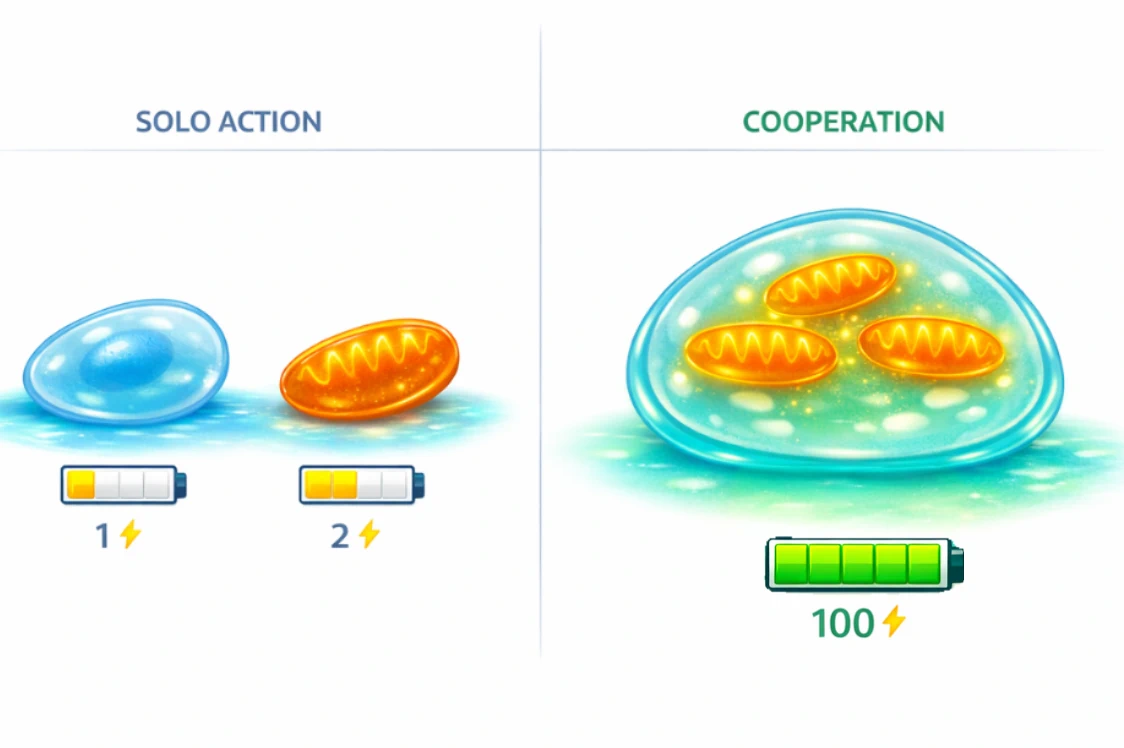
Cooperation is usually read as a behavior, something living things choose to do. Followed honestly from thermodynamics, it is not a behavior at all. It is the first principle of complex life: the mode the universe pays for, shown first by the merger that started all complex life and held in one image. By the end, the first principle of cooperation stands on physics instead of on analogy.
On a cruise ship, over dinner, I once talked with a biologist about her husband’s cooking. He is a NASA engineer, and cooking is his hobby. At some point I said: at the end, we all need to feed our mitochondria. She paused for a long time. A working biologist, stopped by a sentence about dinner. This post is about why that sentence is bigger than it sounds.
What a first principle actually is
A first principle is a truth that cannot be deduced from anything deeper, so everything built on it is derivation, not opinion.
The definition we still use comes from Aristotle, in a lineage that begins with Plato: a first principle is the first basis from which a thing is known (Metaphysics 1013a14-15). You cannot argue your way to it from something shallower. You can only check whether it holds, and then build.
One boundary before the building starts: the first principle of complex life is not a law prior to physics. A law constrains; a principle organizes. Physics is underneath it. The phrase names the most fundamental principle at the layer of complex life itself, and the derivation below holds it to the physics at every step.
The method has a modern wave. Popularized in Silicon Valley by Elon Musk and articulated as a practical toolkit by writers like Shane Parrish, first-principles thinking breaks a problem down to what is irreducible: Socratic questioning, the Five Whys, separating what is known from what is assumed. It is an honest toolkit, and it works. But look at what it is applied to: batteries priced as raw materials, refrigerators improved by thermodynamics, bikes broken into parts. The wave stops at engineering problems.
Here is the step nobody in that wave takes. The toolkit’s own favorite example is the laws of thermodynamics. Take that example seriously, not as a refrigerator’s tool but as the first principle of life itself, and one question opens: what does life run on, and what does thermodynamics pay for? Before deriving the answer, note where the field of cooperation stands. Athena Aktipis (2016) opens her field-defining paper with the honest summary: from cells to societies, several general principles arise again and again that facilitate cooperation and suppress conflict. Her principles are real: walk away, need-based transfers, cheater suppression. But they arise again and again from what? Her paper regulates cooperation from inside, in strategy and payoff language. The word energy does not occur in it at all. Those principles are conventions agents follow, and a convention is not a first principle. The derivation below starts where her paper stops: at the ground floor.
The ground floor: nothing runs on itself
No system can power itself, so every system that stays alive must acquire energy from outside.
This is the contrapositive of every perpetual motion machine ever proposed, and every one of them failed. The second law stands: entropy rises wherever no energy flows in from outside. What stays alive has a name: an open system, an organism that maintains itself in a steady exchange with its environment (Bertalanffy, 1968). The direction of the exchange has a name too, and a correction that matters: life feeds on free energy, not on order in the abstract (Schrödinger, 1944).
So every living thing must acquire. A lone bacterium acquires. A tree acquires. So do you, at every meal. Acquisition is universal and older than cooperation. Cooperation is one mode of organizing it, and the question becomes precise: when does organizing acquisition cooperatively pay more than going solo? The next section answers with a ledger.
Why the physics pays for the cooperative mode
When systems merge under a shared boundary, the pooled system reaches usable energy beyond any part’s solo reach, and the ledger stays positive.
The trigger is structural, not moral. Cooperation emerges where the energy ledger demands more than any unit can deliver alone: acquiring what no unit can reach, converting what no unit can process, or holding what no unit can keep. Below that threshold, solo works. Above it, the demand sits unmet unless units organize.
The gain has a shape that words keep failing, so here is the ledger before and after two cells merge.

Read the image as an energy ledger, not a fuel story. The merged system’s battery is full not because a better fuel arrived, but because it holds more converters under one boundary. Fuel is downstream and interchangeable: hydrogen then, glucose or fat today. The converter was the point, never the fuel. That is why the pattern repeats at every scale where contributors pool capacity.
Three facts keep the ledger honest.
First, pooling is measured, not asserted: inside organisms, biology’s most robust scaling law (Kleiber’s law, the mouse-to-elephant line) shows the efficiency dividend of shared distribution networks, larger organisms delivering energy at lower cost per unit of body mass than small ones. That is the maintenance side of the ledger. The merger in the next section adds the output side: more usable energy per nutrient taken in.
Second, pooling damps risk: shared resources improve the long-run growth rate of a cooperative system by smoothing out fluctuations that can sink a solo system (Peters and Adamou, 2018).
Third, the merged system must still hold a viability threshold: energy in must exceed energy spent, loop after loop, or the boundary dissolves no matter how beautiful the structure.
The external forms of the same principle are exhibits rather than measurements: the ant colony farms what no ant can farm alone, and the coordinated hunt takes prey no lone hunter can take (the energy ledgers behind both examples are on the home page). The pattern is identical, only the boundary differs: internal cooperation inside one organism, external cooperation between organisms, and the merger, covered next, is the moment external cooperation became internal.
And once the merger exists, the principle is detectable at every level of the life that descends from it. Inside your cells: the mitochondria, still pooled with the host after roughly two billion years. Between cells: in every multicellular fungus, plant, and animal, cells descended from the merger cooperate within one body. Between organisms: the ant colony, the wolf pack, the lion pride, and us.
Count the branches of complex life and you are counting millions; the estimates vary by whole millions, and it does not matter. What matters is the word every. Every one of them runs on the same cooperative structure inherited from the merger, and the differences between them are differences of expression: how each branch acquires its energy, and how many cells compose its body.
Those millions are the living count only. The dead branches ran on it too: the dinosaurs for more than a hundred and fifty million years, and one dinosaur lineage, the birds, which carries it still. Extinction removed branches; it never touched the structure.
The defining case: the merger that never came apart
Complex life begins with two cells that pooled their energy budget and never separated.
Lynn Margulis established endosymbiosis with microbiological evidence in 1967 and made this merger textbook biology. She and Dorion Sagan named what it means: “Life did not take over the globe by combat, but by networking” (Margulis and Sagan, 1986). The post’s word for her networking is cooperation.
Billions of years ago, a host cell took in a bacterium, and the bacterium stayed. The first exchange between them was chemistry, not kindness: in the hydrogen hypothesis, the host needed hydrogen, and the symbiont produced it as waste (Martin and Müller, 1998). One organism’s exhaust became another organism’s input. That was the first reciprocal interface.
The gain was immediate, and it is measurable today. Before the merger, cells produced ATP through simple fermentation. After the merger, the combined system could extract far more ATP using oxygen, processing a wider range of fuels. The same fuel molecule yielded roughly sixteen times more usable energy.
The host provided nutrients. The symbiont provided scaled ATP output. Lineages that kept this partnership gained more usable energy per nutrient, and they reproduced more successfully. Almost every cell in your body still carries the descendants of this alliance: mitochondria, the converters at the center of the image above.
The deeper advantage was per gene. The calculation: a bacterium scaled up to a eukaryote’s gene count would command about 4,600 times less energy per gene than the eukaryote commands (Lane and Martin, 2010). Mitochondrial power made complexity affordable. It enabled a 200,000-fold expansion in the number of genes expressed, and that leap in genomic capacity was the prerequisite for everything complex life became.
Physics permits this merger and explains why it pays, but it does not compel it. It happened just once in four billion years, and prokaryotes show no tendency toward greater complexity (Lane and Martin, 2010). The merger was not inevitable. The physics explains the constraint and the payoff; history supplied the event. It cannot be deduced from the physics, only checked against it, and then built on.
A solo cell cannot generate the energy complexity requires. A cooperative cell system can, and it did. Cooperation is not what complex life does. It is what complex life is made of.
Which brings the derivation to its plain-language conclusion, the sentence that stopped a biologist at dinner: cooperation is the shared organization of food for energy to sustain life. The sentence is dinner-table small. What it compresses is the whole derivation: energy acquired from outside, organized by structure, sustaining life at every scale, from the merger to the meal. And the meal still runs on the merger: every thought at that dinner table, every word of this post, powered by the surplus two cells pooled roughly two billion years ago.
Frequently Asked Questions
The question is a category error once cooperation is read structurally. Human children are born with the capacity: toddlers help spontaneously before any training (Warneken and Tomasello, 2006), and rewards do not build this tendency, they undermine it. Three-year-olds who pull a reward together share it almost perfectly evenly, even though nobody showed them the sharing rule; only the pulling was demonstrated (Warneken et al., 2011). Michael Tomasello’s word for this is capacity: the structure is inherited, the behaviors are trained expressions of it. Nature supplies the structure, nurture tunes the behaviors, and the old debate was arguing about neither (Tomasello, 2009).
No. It requires energy and a held threshold. In the derivation, a cooperative system persists because the pooled ledger stays positive: more usable energy acquired and organized than each contributor could reach alone, with every contributor held above viability. Altruism is one possible behavior inside such a system, never its engine. This is why cooperation appears in systems that cannot be altruistic at all, like cells, colonies, and tissues.
For the same structural reason life at every scale does: the energy ledger demands more than solo reach can deliver. A wolf pack takes prey no lone wolf can hold; an ant colony farms fungus no ant can grow alone. Across biology, cooperation appears wherever pooling capacity does what solo effort cannot, and it breaks down wherever the shared ledger stops holding, as in cancer, where cells stop contributing to the organism’s cooperative economy.
Because it is a ledger, not a law of feeling. A cooperative system persists while energy in exceeds energy out for the system and viability holds for contributors. Cheaters, parasites, and exploitation are drainage on that ledger, and real systems police them, as Aktipis’s cheater suppression describes. When the surplus disappears, the structure loses its physical support, regardless of anyone’s intentions.
Aktipis (2016) describes three working principles: walk away, need-based transfers, and cheater suppression. They are real, and they regulate cooperation from inside it, in strategy and payoff language. A first principle is different in kind: it is what those principles arise from. Cooperation organized around energy is upstream of the strategies that stabilize any particular cooperation. Her paper never uses the word energy; this post derives the first principle of cooperation from it.
The derivation ends at the merger. The full story of that merger, from the first hydrogen exchange to the cells you are thinking with, is told in The Cooperative Ancestor.
Energy First explains the structure behind the Principle of Cooperation: how energy shapes life, how cooperation emerges, and why the same pattern appears in biology and in the systems we build. Get Energy First on Amazon.
The framework lives at tpoco.org. More writings on the principle of cooperation are in preparation.
I use AI responsibly. AI wrote with me, not for me: the thinking, the decisions, and the responsibility are mine.
Leave a Reply